















Introducing Annie Frost Nicholson
We’re welcoming Annie Frost Nicholson to Breed with a Q&A so you can get to know her a little.
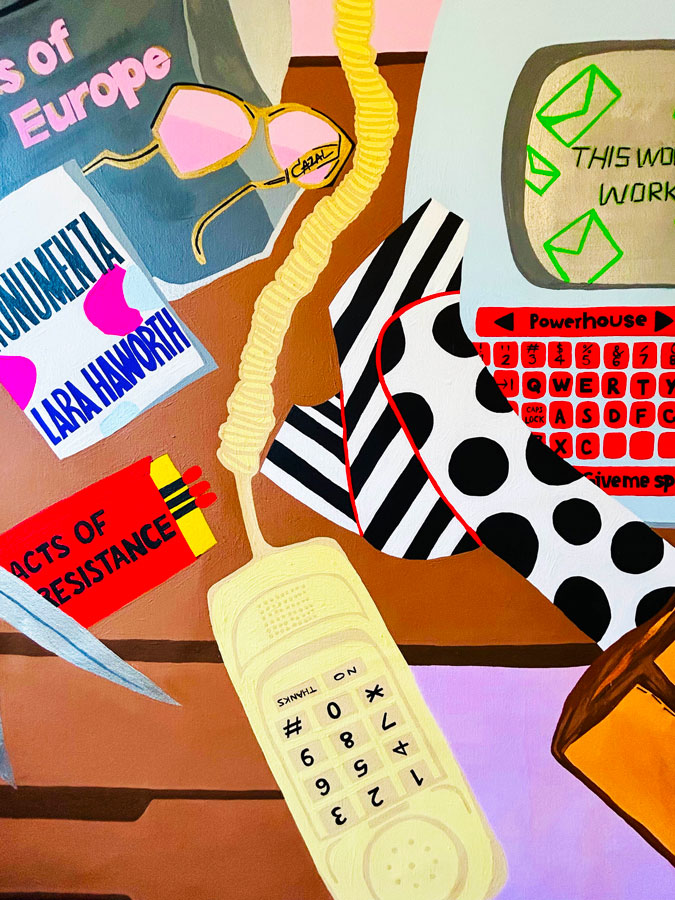
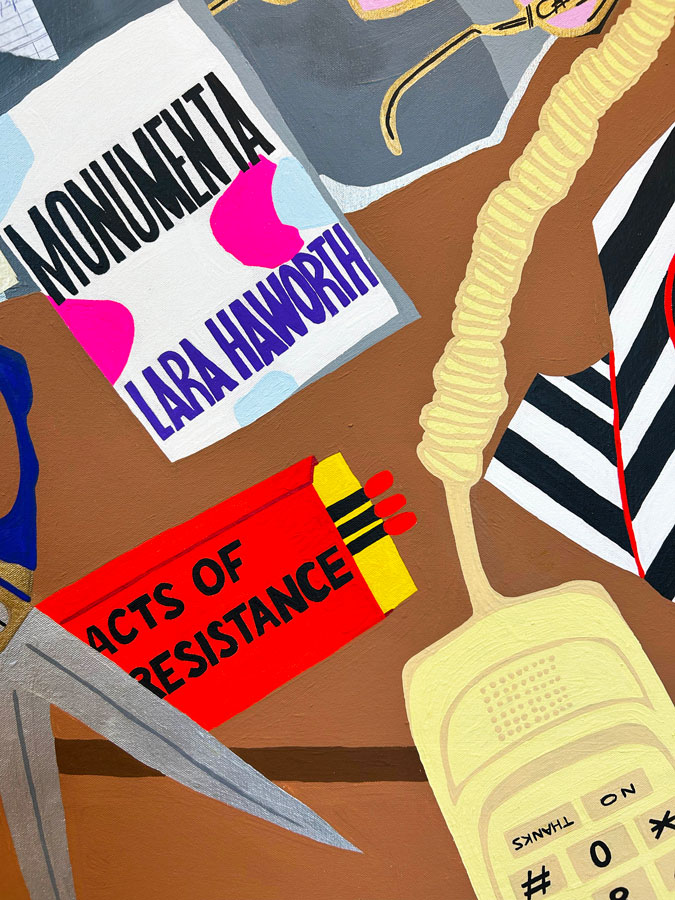
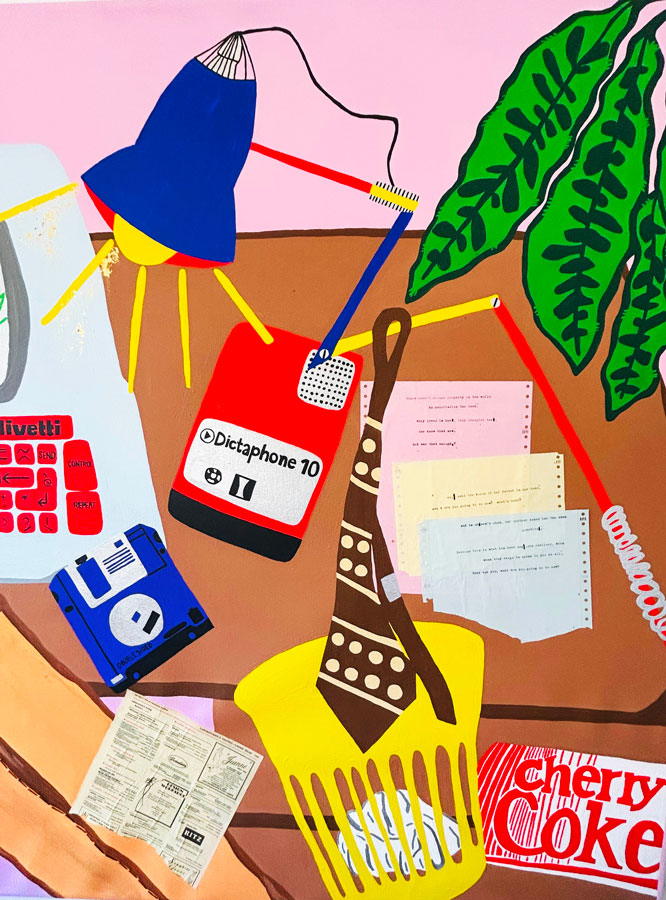
Annie’s artistic life has had distinct phases, focusing on familiar items used by many of us in the past and present to communicate and the ways and means we make connections with others. Initially that saw her painting highly stylised versions of such analogue objects as dial phones, Walkmans, and cameras. From there she moved into creating environments like Fandangoe Discoteca, a mini club where people were encouraged to dance away feelings of grief.
Most recently, Annie has been turning some of the objects of her paintings into giant 3D versions that people can interact with.
Over to Annie to introduce herself and her work:
What were your earliest experiences of art?
My parents were always taking on these monumental ‘projects’ around the house when I was a kid and because of that, things were always moving around in spaces, new colours getting put onto walls seemingly quite spontaneously, legs chopped off tables, radical transformations on a regular basis. They were good at making homes where everyone wanted to gather and talk and so much of this was in the detail, so I paid a lot of attention to that. My mum would take me to local galleries and shows and both parents were, in hindsight, probably quite unusual for the time (or any time). They would choose one room and everything in it would be hues of one single colour. It was the same with what they wore. I suppose this attention to detail rubbed off and I definitely use colour to tell stories where sometimes words fail.
When did you first start painting?
I was always painting something as a kid. Furniture, shoes, walls, whatever anyone would let me have. I remember it being a real thrill to apply paint as a young person and I still find that first dose of a new colour on a surface exciting. Anything could happen!
Did you go to art school?
No, not at first. I did a BA in French and Italian and as part of that I studied at the Sorbonne in Paris for a year, which is still one of the best times of my life and I think this is where I started to see how interested I am in language and narrative as part of what is now my creative practice. After the BA, I studied Graphic Design at London College of Communication on a course that no longer exists, while I was working in my first job at the British Film Institute. I guess I was pulling together all of these strands that now constitute my practice. A few years later I did a part-time MA at Goldsmiths called Artist Teachers and Contemporary Practices, which really helped a lot with the socially engaged, educator part of my work.
How would you describe your artistic style?
I’m interested in what I make people feel, first and foremost. I think about this at length before I even start to make or design something and then I build this outwards, so with both an experiential piece or a painting, I construct them through drawings, on the bus, on the sofa, wherever. Colour and narrative and the delicate balance between them are very important, as is accessibility on multiple levels and holding a balance between the personal and the universal. Audiences are very important to me, especially with the installation work, I’m always really involved in the public programming and how to look after the public when they are engaging with a work that may well prompt a range of emotions.
Were there any big influences on your style when you were finding your feet?
Yes! Two of my dearest friends, Camille Walala and Tara Darby had a profound impact on the early days of my working life. Camille and I lived together for years, when she was just starting out and I was a student and have been through all the ups and downs of this creative life we have chosen. Her way of seeing the world has always given me a spring in the step and she’s always believed in me throughout the toughest of times. Tara and I met years later and had one coffee and decided to make a film together, which was, as it turned out, the beginning of something significant in my practice. Both have been major influences especially during some hard knocks in life and their way of seeing the world and engaging with people is endlessly inspiring. Other artists and writers I don’t know who have had a huge impact on my work are Sophie Calle, Rose Wylie, Nathalie Du Pasquier, Jenny Erpenbeck and the photographer Gillian Laub.
What was the intention behind your painted pieces – why objects like old phones and cameras?
I’m always thinking about worlds that I can invite people into with the paintings. There’s such a joy in being able to construct a new painting, to think about objects as holders of stories, to merge timescales and to evoke memory through a composition. Some of the narrative threads that I sew into a painting may come from a dream, or something a parent or a family member may have said to me once, a million years ago and it gets woven into a different era, so it can (hopefully) speak to people about their own journey through this life and their own experience of the world. The Sony Walkman or the Nokia 3310 that feature in some works have sparked endless conversations with the public about their own memories, which I just love. This is when I know a piece is working.
What instigated your evolution to more experiential works?
Looking back, it was probably inevitable as from the very beginning, I have wanted to use the work as a way to engage with all kinds of people, about bigger parts of the human condition and how we live, what matters. Developing experiential structures really gave me the chance to think about all aspects of public need and how to collaborate effectively to try to accommodate them. Working with sound and lighting designers, spatial designers and charities for public programming has been life changing as we have been able to build spaces that (hopefully) can invite you to take a pause from the outside world. It has been amazing to see the public engaging with works that ask them to think about wider existential and socio-political subjects such as shame, Brexit etc (!) through the medium of an art installation and to gather all of the feedback, stories and responses to the work through the public programme.
How do you feel your illustrative works align with your paintings?
Again, I think the main job is to understand your audience and the people engaging with a piece of work, and so I always work backwards from how I would endeavour to make people feel including all the multitudes they may contain and go from there. There’s always a personal touch in every work, sometimes more subtle and hidden than others but always part of the wider practice and recognisable in terms of iconography, colour, style.
Do you think art’s ability to help people deal with grief, painful memories and loss is overlooked?
I think artists have been engaging with these subjects forever but perhaps there is wider public consciousness around loss post-Covid, for example, and we have a more fluid language for speaking about it. This is thanks, in part, to artists. It’s interesting to me that Tracey Emin is now a ’national treasure’ after 30 years of making work on grief, painful memories and loss, having been vilified by the mainstream press for decades. Artists have always had a unique ability to treat and reflect the most complex aspects of human existence and their relationship with politics and society. This is where I think public art can be really effective at reaching people: it crashes through class and accessibility and people who wouldn’t normally go into a gallery or institution can happen upon something and be transformed. And I know this to be true.
Do you think there’s a real danger of technology almost encouraging people to become passive observers rather than active participants in the world?
I do. I think we have to keep reminding ourselves that when the tool that is supposed to make our lives easier and more efficient – the phone, the screen – becomes the thing that zaps all of our energy, we have to reset and remember our own social muscle to communicate, to engage without the tech. Luckily, this really is a muscle and can be honed, trained, worked on, even when depleted by doomscrolling. When I see people walking around London, head down bumping into people because they are glued to their screens, I know we have a problem. But I don’t think it’s one we are beholden to and there are so many brilliant people who are encouraging a return to this active participation in the world, to the art of noticing, looking, engaging. I think it’s becoming more and more important, and people are really realising this.
What is the thinking behind your recent work in large-scale 3D pieces?
It’s really a way to merge the two great loves in my work, painting and experiential design and to use these many years of working in installation and public realm work to think about how to reach people with some new works, ones that have emerged from the paintings. I understand that fewer people would stand in front of a painting featuring some of these analogue objects than would engage in something in a public setting where you can step into the object and reflect on memory, a world without so many screens and distractions, so it feels timely. More and more when I work with young people each week at Chelsea College of Art, where I teach, I hear students saying that they hate their phones, that they have started shooting on film, that they are interested in the freedom of a time when we weren’t always reachable. They are much more boundaried about it all than we may think, because they are also better at drawing parallels between screentime and mental health and talking about their needs generally. So, it seems to me through these conversations over a long period of time that there is a need and a longing for the analogue experience. We have arrived in a time of chronic multitasking, with news and notifications coming in left, right and centre and we are overloaded. This work is an opportunity to refocus, to cut out the excess noise, to get back into our bodies and to reclaim a bit of ourselves and our communities.
Is the intention for these installations connect with local community groups?
Yes. We are living in a time where community has never felt more essential. I think it’s our way out of the doom of authoritarianism, which seeks to divide and break community. It’s an invitation to stop, to put your phone down, to talk, to listen, to be cocooned for ten minutes of your day. If you reach a few thousand people a day and this experience of active listening and participating happens and they tell their circle of people, you can really effect some kind of change with an artwork.
Have you made real connections with people who come to see your art?
Yes. We have really built a community with works like Discoteca and Juicy Booth. Through the public programme, we have been able to track engagement and gather public feedback, which has been invaluable to how we progress with future installations. It has been touching to hear so many personal stories that have been evoked through visiting these works, often from people who were passing by. In fact, some of the best stories have come from people who never have any intention of engaging with a piece of artwork.
Which piece of your own work means the most to you?
Discoteca is really important to me. It was such a collaborative effort and a labour of love to get funded and off the ground and it has come so far from its inaugural installation in 2023. Everyone involved in this piece has become truly like family at this point and we really trust each other to get the job done, often against all the odds and logistical nightmares! Seeing the piece at the Southbank Centre last summer for their Dance Your Way Home season led by the brilliant Emma Warren was such a highlight. The programming work of Carly Attridge at The Loss Project and the endless tweaking from K67 Berlin and their team to make it a really special experience has just been invaluable.
Do tell us about your London studio set up.
Last year, my partner and I borrowed a bit of money from the bank and decided to build a studio as part of the house we live in, in Peckham. We worked with architects and friends Caukin to design a studio which is kind of an L shape, which is part of the house, but has a separate door and lots of good light. I have a big wall for painting, all my books and an old piece of neon that my sister bought me, which I turn on at night and it gives the whole house a nice pink glow! It overlooks Nunhead Cemetery and is really a special space to work. I can get so much more done at any time, which I love.
Do you have ideas for what you want to do in the future?
Alongside the plans above, I would love to develop an experiential space to invite people to reflect on climate change and the plethora of feelings this engenders in our society. Ecological despair and anxiety comes up more and more in our public-facing work with current installations, so it feels timely and important. We have some early renders of how this space may look so I’m excited to move it forward.